Bill Gates on AI Risk and Self-Regulation
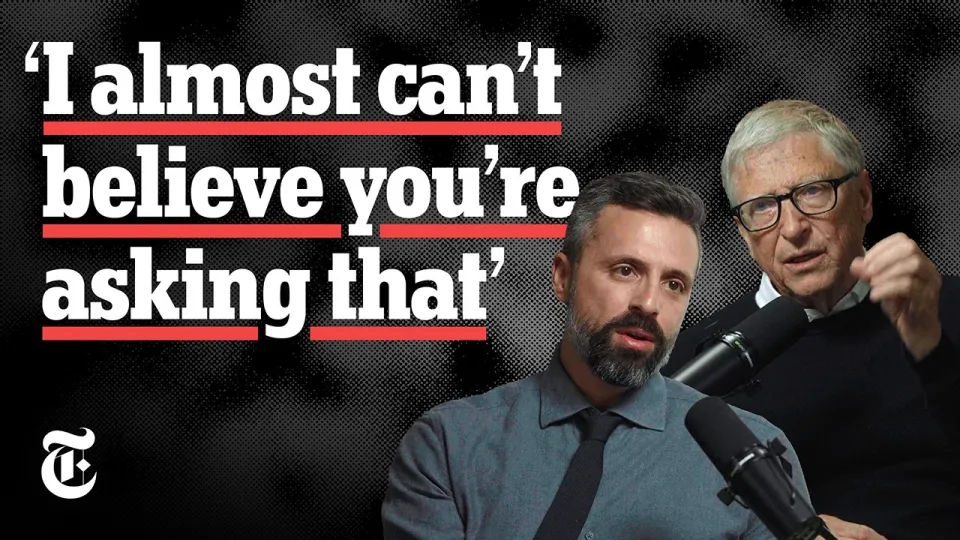
Video: Bill Gates: A.I. ‘Makes Nuclear Weapons Look Like Nothing’ | The Ezra Klein Show
Want articles like this for your own video to promote it on YouTube and Google? Order them through the Telegram bot @sat_sit_bot. It writes articles around your video, embeds the video and publishes them on popular niche websites (no ads). Try it free: 50 articles on us.
Key takeaways
- Gates calls AI the most dangerous technology humans have approached, saying it makes nuclear weapons 'look like nothing.'
- He identifies cyberattacks and bioterrorism as the two thresholds where AI risk becomes catastrophic.
- Gates calls the idea that the AI industry can self-regulate 'insane' and compares relying on lawsuits to ignoring a mass-casualty event.
- He frames the AI race with China as a reason safety work cannot be voluntary or slow.
- The Gates Foundation has made AI-driven inequality a new priority, alongside roughly $200 billion in planned spending over two decades.
Bill Gates argues that artificial intelligence is the most dangerous technology humanity has ever approached, and that the idea the AI industry can police itself is "insane." In a conversation with Ezra Klein, he says AI risks make nuclear weapons "look like nothing" and warns that catastrophic cyberattacks, bioterrorism and mass job loss are plausible unless governments act. The full interview and transcript are available through The Ezra Klein Show episode page.
Gates is not a newcomer to the debate. The Microsoft co-founder spent years as a cautious optimist about computing, and he has publicly shifted from dismissing AI alarmism to arguing that it has not gone far enough. His foundation, which plans to spend down around $200 billion over the next two decades, has added a new priority: making AI a force for equality rather than a driver of inequality.
What Gates used to think about AI
Gates' position changed as models crossed a threshold he describes as superhuman in specific domains. For years he treated AI as a tool that would mostly augment human work, similar to earlier software revolutions. What moved him was seeing systems outperform experts on well-defined tasks, then generalize faster than expected. That shift is why he now talks about AI as a governance problem rather than a product cycle.
Cyber and bio thresholds
Gates points to two concrete danger zones where AI changes the scale of harm: cyber and biology. In cybersecurity, model-assisted attacks could let small groups compromise infrastructure that previously required state resources. In biology, tools that lower the cost of designing pathogens raise the possibility of bioterrorism by actors with limited lab capacity. Gates frames these as thresholds rather than hypotheticals, which is why he treats voluntary safety commitments as insufficient.
Why self-regulation fails
Gates calls industry self-regulation "insane" because competitive pressure rewards speed over caution. His argument is simple: if one lab slows down, another advances, and the market does not price catastrophic risk. He also rejects the idea that courts are the right backstop, asking how a lawsuit could address an event that kills 100 million people. Regulation, in his view, has to be set by governments before the damage occurs, not after.
The race with China
Gates treats the AI competition with China as a reason for coordinated safety rules, not a reason to abandon them. He argues that a race dynamic makes voluntary restraint fragile, because each side fears falling behind. The practical implication is that safety standards need to be international and built into the technology itself, so compliance does not depend on any single company's goodwill.
How AI will disrupt jobs
Gates expects AI to reshape work faster than previous automation waves, hitting white-collar tasks that were long considered safe. He describes a possible no-scarcity job market in which productivity gains lower costs but wages do not automatically follow. Among the policy ideas he discusses are taxing AI labor, creating "human reserved" roles where people are required by design, and using AI to preserve global languages that lack digital support. He also warns that developing economies could be hit hardest, because the inequity is allowed to exist at a distance.
Common questions about Gates' warning
Viewers of the interview raised several recurring doubts. One is whether Gates is overstating the danger; his answer is that the risk is not that AI becomes evil, but that capability outruns the institutions meant to contain it. Another is whether regulation would hand an advantage to rivals; Gates argues that unregulated competition is the bigger threat. A third is whether capitalism self-corrects; he is skeptical, noting that markets have repeatedly failed to prevent harms when profits and safety diverge. A fourth is whether his foundation's spending can offset the inequality AI creates, which he treats as a reason to set policy, not a substitute for it.
Useful links
The full transcript and episode page: https://www.nytimes.com/2026/09/29/opinion/ezra-klein-podcast-bill-gates.html
Book recommendations from guests of the show: https://www.nytimes.com/article/ezra-klein-show-book-recs.html
The bottom line
Gates' message is that AI capability is advancing faster than the rules meant to govern it, and that voluntary industry pledges and lawsuits are not a substitute for law. He wants governments to set thresholds for cyber and bio risk, coordinate internationally, and prepare for labor disruption rather than react to it. The interview, produced by The Ezra Klein Show, is worth watching in full for the exchange itself, including the moments where Gates pushes back hard on the framing of the questions. For the complete conversation and transcript, visit the episode page.
Source: Bill Gates: A.I. ‘Makes Nuclear Weapons Look Like Nothing’ | The Ezra Klein Show · Markdown version
Questions & answers
Why does Bill Gates say AI makes nuclear weapons look like nothing?
Gates argues that AI lowers the barrier to catastrophic harm in cyber and biology, letting small groups cause damage that once required states. Nuclear weapons are bounded by physics and materials; AI risk scales with software and access, which is why he treats it as a broader threat.
Why does Gates call AI self-regulation insane?
He believes competitive pressure rewards speed over caution, so voluntary commitments collapse when one lab advances. In his view, markets do not price catastrophic risk, and courts cannot address events with mass casualties after the fact.
What does Gates propose for jobs displaced by AI?
He discusses taxing AI labor, creating human-reserved roles, and using productivity gains to support a no-scarcity job market. He also warns that developing nations could absorb the worst disruption because the inequity is allowed to exist at a distance.
Is Gates optimistic or pessimistic about AI?
He is neither a pure alarmist nor a cheerleader. He sees major benefits in health, education and language preservation, but insists those gains depend on governments setting safety thresholds before damage occurs rather than after.